
The questions.
The emails.
The document requests that feel endless and random.
That stage has a name on the buyer side: due diligence.
And one of the most powerful tools you can use to get through it faster, with less stress and more control, is something many owners have never heard of: a data room.
In this article, you will see:
If you are 1–5 years away from maybe selling, this is one of the highest-leverage places to spend a little time now to save yourself a lot of pain later.
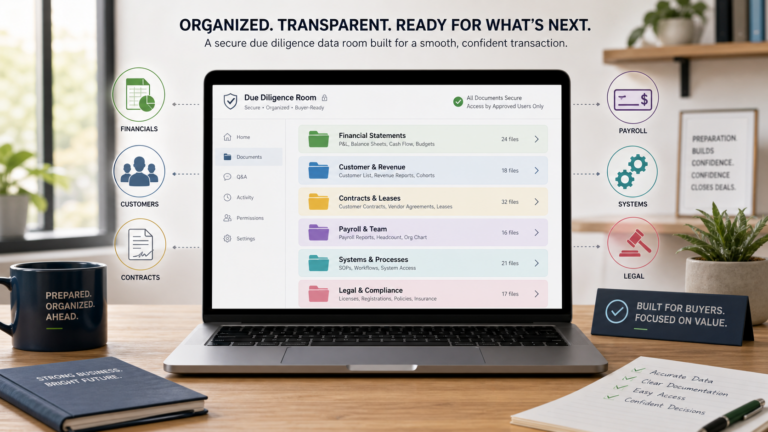
On the buyer side, a data room is simply a secure, organized online folder where the seller keeps the information buyers need to evaluate the business.
Think of it as the backstage of your company:
The financials, contracts, systems, and key documents that tell the real story of how your business runs.
For a small, service-based business like yours, a data room usually includes:
It is not a fancy piece of software.
It is a well-structured home for the information buyers always ask for.
On the buyer side, walking into a deal and finding a ready data room feels like this:
That is the feeling you want to create for the right buyer.

Without a data room, most deals fall into the same pattern.
A buyer asks for “some basic financials.”
You pull something together from your accountant.
A week passes.
They ask a few follow-up questions.
You dig a little deeper.
Another week goes by.
Then they request customer concentration details, contracts, payroll reports, tax returns, or proof of certain expenses.
You are running the business at the same time, so every new request feels like a mini fire drill.
This creates three problems:
None of this is because you are doing anything wrong as an owner.
You built a business, not a transaction-ready file system.
A data room exists to fix this.
When your data room is in place before serious buyers show up, three powerful shifts happen.
Instead of sending requests one at a time, buyers log in and see:
They can review more in one sitting, make decisions faster, and ask better questions.
You are not hunting for documents between service calls or after dinner.
Speed does not come from pushing buyers.
It comes from removing friction.
When your documents are ready and organized, you stop being the bottleneck.
You decide:
Instead of sending random PDFs from your inbox, you invite them into a structured space.
The message is subtle but strong: “This is a real business, and this is a real process.”
That posture matters more than most owners realize.
Buyers are not looking for perfection.
They are looking for a story they can understand and believe.
A ready data room lets your numbers say:
When your information is organized, you can guide the narrative instead of defending yourself.
That confidence is exactly what buyers are hoping to see.
Due diligence is not just a spreadsheet exercise.
It is emotional.
Owners often describe it as:
A ready data room does not magically make the emotions disappear.
But it does remove one huge source of anxiety: the fear of being caught off guard.
When you have:
You walk into those conversations with a very different energy.
You are informed, not guessing.
You are prepared, not scrambling.
For someone like you—who cares about legacy, reputation, and doing right by your team—that matters.
The exact structure can vary, but here is a practical, service-business-friendly view of the categories buyers usually expect.
The goal is not perfection.
It is clarity and consistency.
Buyers want to understand where the money comes from and how fragile or stable it is.

This helps buyers understand your team, cost structure, and key-person risk.
You do not need a franchise manual.
You need enough structure so a buyer can see how another person could step into ownership.
Buyers want to know there are no obvious landmines.
If you work with a broker, they might host the data room on their system.
That does not mean you should wait to start gathering documents.
One of the best gifts you can give your future self is to have your own data room structure ready before you ever interview brokers.
When you do, you:
Brokers can host the room.
Only you can do the work of knowing where everything lives and pulling it together over time.
You might be thinking:
“I am not ready to sell right now. Why would I go through all this?”
A fair question.
Gathering due diligence items is not trivial.
It takes time, focus, and more energy than most owners expect.
Starting early is not busywork.
It is the opposite of wasting time.
There are three reasons to build your data room long before you are ready to list.
When you wait until a deal is on the table, every document request is urgent.
You are reacting to someone else’s timeline.
When you start early, you can:
Instead of dropping everything to chase one more report, you chip away while you keep running the business.
You save your future self from trying to do full-time due diligence work on top of full-time ownership.
As you gather documents, you might spot:
You also learn where everything lives.
So when you need to update numbers or pull a fresh report later, you are not scrambling to remember which system or folder holds what.
Seeing these things 2–5 years before a sale gives you time to improve your story instead of apologizing for it.
When your house is in order behind the scenes, you are not locked into one path.
You can:
A ready data room does not force a decision.
It gives you options—without turning your current life upside down.

An owner I know recently sold a laundromat before going on to acquire a window cleaning company.
Before she ever talked to buyers about the laundromat, she built her full data room: Every due diligence item organized, labeled, and ready to share the moment a serious buyer stepped up.
Here is what happened next:
Laundromats are relatively simple businesses compared to many service companies.
But this example shows what a ready data room does in real life:
Your business might be more complex.
Your deal probably will not close in 15 days.
But the principle scales:
When the right buyer shows up and your data room is ready, you make it as easy as possible for them to say “yes” and move forward.
You Are Not Doing the Buyer’s Homework
Some owners worry building a data room “for the buyer” means they are doing the buyer’s job.
That is not what is happening.
You are building:
Each buyer will have their own tailored list of questions and follow-up requests.
You probably will not build a truly exhaustive data room.
But if you are 70–80% of the way there before the first buyer shows up, you are not doing their homework.
You are making sure you are not redoing yours over and over under pressure.
Numbers do not tell the whole story by themselves.
Whenever something in your financials, history, operations, or legal file might look unusual to an outsider, add a short narrative:
Write a simple explanation in plain language.
These narratives help a buyer understand the deeper functioning of your business and keep them from filling in the blanks with worst-case assumptions.
You are not trying to spin anything.
You are giving context so your business is evaluated fairly.

What “Ready” Looks Like (You Don’t Need a Perfect Binder)
Many owners hear “data room” and picture something polished and intimidating.
In practice, for a small service-based business, “ready” might look like:
Buyers do not expect you to operate like a giant corporation.
They do expect:
If you can hit those marks, you are ahead of most small owners.
Let’s bring this back to the original promise: closing deals faster.
In small business acquisitions, there is a saying for this: time kills all deals.
A ready data room speeds things up because:
On top of that, your readiness sends a signal:
Deals fall apart when uncertainty grows faster than trust.
A ready data room quietly builds trust.

From the buyer’s chair, one pattern shows up again and again.
The owner says:
But behind the scenes:
They are not bad owners.
They just have not done this before.
When the buyer starts asking questions, it feels like an attack.
The owner gets defensive or overwhelmed.
Responses get slower.
Momentum dies.
This is how good businesses end up selling for less than they should—or not selling at all.
A data room is not busywork.
It is how you protect the outcome you say you want.
This is not theory for HCW Biz Advisors.
Working with sellers, the data room is one of the core deliverables built together over time.
The work looks like:
The goal is not to turn you into a deal professional.
The goal is to help you feel prepared, confident, and in control when real buyers show up.
You do not have to wait until you are ready to list to start this.
In fact, the earlier you start, the easier it is.
If the idea of a full data room feels big, here is a small, concrete way to begin.
Over the next 30 days, choose one of these:
If you do only one of these this month, you are closer to a real data room than most owners who say they want to sell.
If you are quietly thinking, “I know I should do this, but I do not even know where to start,” you are exactly who HCW Biz Advisors is built for.
Here is an easy next step:
Book a free, low-pressure strategy call with HCW Biz Advisors.
On that call, you will:
No pressure to list.
No obligation to work together.
Just a clear, human conversation about what it would take to make a future sale faster, smoother, and less painful—whenever you decide the time is right.
If you are 1–5 years away from maybe selling your service-based business, this is the most practical place to begin.
