
This article provides general seller-readiness education, not legal, tax, accounting, valuation, or lending advice. Treatment varies by transaction structure and agreement. Work with your CPA, transaction attorney, broker or M&A advisor, and the buyer’s lender as appropriate.

You’ve agreed on a price for your business.
Then someone asks what’s included.
“Well, I’m keeping the money in the bank. And the customers still owe me for work we’ve already done, so I’m keeping those receivables. Inventory is extra, of course.”
Meanwhile, the buyer expects enough inventory to keep operating and wants to know who’s paying the outstanding vendor bills.
You agreed on the number. You haven’t agreed on what the number buys.
This is how a conversation everyone thought was settled suddenly needs three spreadsheets, two advisors, and a walk around the block.
When you’re selling a business, the purchase price matters. But so does what the buyer receives for it, which obligations remain with you, and how the business will fund its operations after closing.
How you handle accounts receivable when selling a business matters. Like inventory, those receivables are business assets, not automatically extra money you collect on top of the purchase price. They’re business assets whose treatment needs to be negotiated. And working capital isn’t another name for whatever happens to be sitting in the checking account.
Let’s sort out the distinctions before they become an unpleasant surprise.
This article provides general seller readiness education, not legal, tax, accounting, valuation, or lending advice. Treatment varies by transaction structure and agreement. Work with your CPA, transaction attorney, broker or M&A advisor, and the buyer’s lender as appropriate.
When someone buys an established small business, they’re generally buying its earning power.
In many owner-operated businesses, the starting point is seller’s discretionary earnings, or SDE: the total financial benefit the business produces for one working owner. SDE commonly serves as the basis for an income-based valuation.
The buyer isn’t buying a number on your P&L. They’re buying the business capable of producing it: the equipment, inventory, customer relationships, systems, and other operating assets working together.
If the asking price is based on what the whole operation earns, we need to be clear about how much of the whole operation comes with it. They’re also looking at the story behind those earnings, including which results are repeatable and which came from unusual circumstances.
From a buyer’s perspective, the purchase price should include the normal operating assets needed to support the earnings used to justify it, unless the price and terms explicitly account for something different.
If the price is based on the earnings of a functioning business, the buyer needs the resources required to keep it functioning. You can’t price the whole operation, then discover halfway through negotiations some of the essential pieces cost extra.
That doesn’t mean every balance sheet asset automatically transfers. The purchase agreement identifies the assets purchased and liabilities assumed. It means any exclusions need to be clear from the beginning, with their effect on the purchase price and the buyer’s funding needs understood.
This article focuses primarily on an asset sale of an ongoing business: the buyer purchases specified business assets and assumes the liabilities identified in the purchase agreement. The seller’s legal entity remains with the seller.
A stock or other equity sale works differently. The buyer purchases ownership of the entity itself, which generally continues to own its assets and owe its liabilities. Cash, debt, receivables, inventory, and working capital still need careful negotiation, but the legal mechanics differ. Don’t assume the same treatment applies to both structures.
In either case, agreeing on a price isn’t enough. You also need to agree on what the transaction includes.
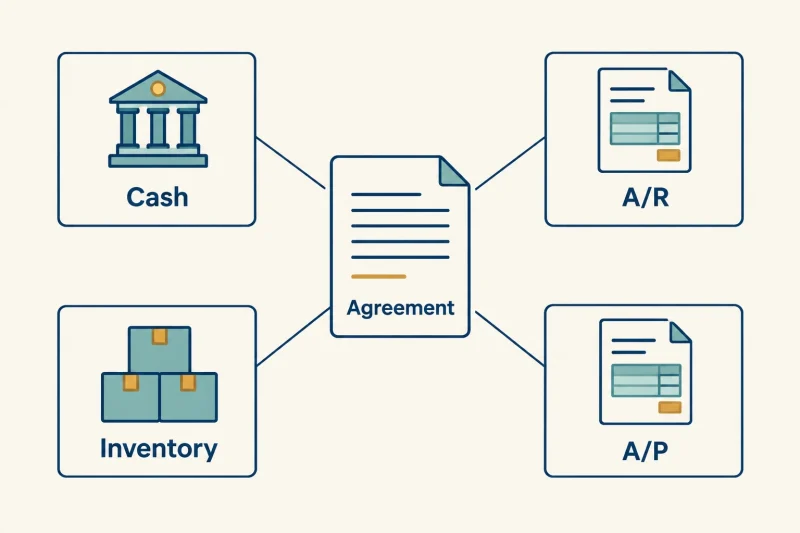
Many business sales are negotiated on a cash-free, debt-free basis. Broadly, the seller retains the cash and settles the debt identified in the purchase agreement. But those words don’t define every asset and liability in the transaction.
They don’t automatically answer:
Cash-free doesn’t mean receivables-free or inventory-free. And debt-free doesn’t necessarily mean every ordinary operating payable disappears. Transaction agreements often distinguish financing debt from operating liabilities such as accounts payable. The definitions matter.
Before anyone starts mentally spending the sale proceeds, you need to agree on what those proceeds are buying.
Accounts receivable, or A/R, represents money customers owe the business for goods or services already provided.
It may become cash when customers pay. Until then, it’s a receivable.
That distinction matters because not every invoice gets paid on time, in full, or at all. During due diligence, buyers will look at the age of the receivables, payment history, disputes, and collectibility, not just the total on the balance sheet.
From your perspective, keeping the A/R may feel obvious:
We did the work before closing. That money belongs to us.
That’s an understandable starting point. It isn’t the end of the negotiation.
In some transactions, the seller retains pre-closing receivables. In others, receivables transfer to the buyer as part of the business’s agreed working capital. Their treatment affects the deal economics.
Keeping the A/R isn’t automatically unreasonable. But if you keep it, the buyer needs to understand how the business will pay its expenses while waiting for new, post-closing invoices to turn into cash.
Payroll doesn’t agree to wait just because ownership changed on Tuesday.
The question isn’t simply, “Who earned the revenue?”
It’s also, “What’s transferring, what obligations accompany it, and how will the business keep operating?”
Accounts payable, or A/P, represents amounts the business owes its vendors.
A seller may want to keep the customer payments coming in while having the buyer cover the vendor bills going out. But that combination isn’t something to assume.
A/R and A/P both affect the resources available to operate the business, and both need explicit treatment in the purchase agreement. In some asset transactions, sellers retain receivables and payables. In other structures, they transfer as part of the agreed working capital arrangement.
Consider a simplified, hypothetical service business with:
The seller expects to keep the $120,000, charge separately for the inventory, and leave the vendor bills with the buyer.
The buyer thought the offer included the operating resources needed to continue the business.
Neither party has necessarily changed the headline price. But they haven’t agreed on the same transaction.
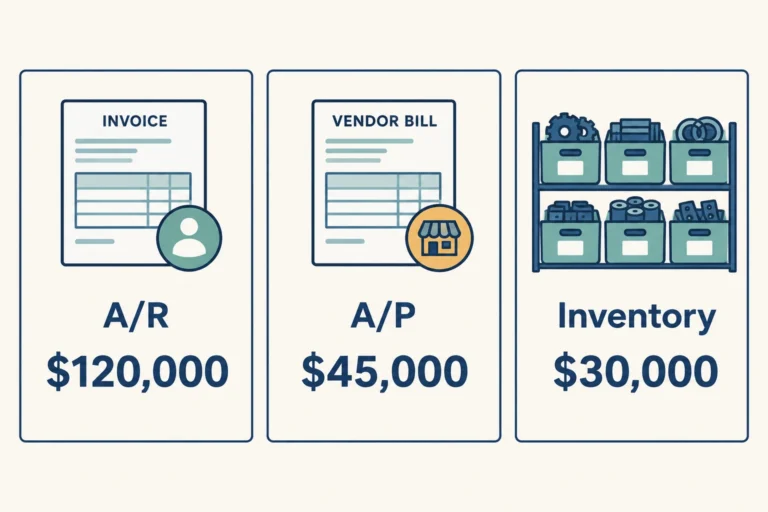
Those three balances also don’t tell us the business’s actual cash needs. Collection timing, payroll, upcoming purchases, and other expenses still matter.
The point is simpler: you can negotiate who receives the assets and who assumes the obligations. You can’t treat the benefits as yours and the responsibilities as automatically someone else’s.
For a business being sold as an ongoing operation, a normal amount of usable inventory should generally be part of the purchase price conversation, not a surprise charge after everyone agrees on the number.
BizBuySell’s guidance on inventory in a business sale describes normal operating inventory as typically included in a professionally brokered asking price, while emphasizing the need to confirm what a particular listing includes.
There are exceptions and different conventions. Some businesses, particularly in retail, negotiate inventory separately. A separate inventory payment can be legitimate when the price and structure reflect it.
But “inventory is always extra” isn’t a universal rule, either.
From a buyer’s perspective, the question is:
Does the price buy a functioning business with its normal operating assets, or do I need to fund those assets separately?
If a service business needs parts on its shelves and in its vehicles to complete normal jobs, those parts aren’t decorative. They help produce the earnings supporting the asking price.
Agree early on:
Including inventory doesn’t mean giving it away. It means being clear about where you’re being paid for it: within the purchase price or through a separately negotiated amount.
“Included” and “free” are not the same thing.
A buyer needs inventory the business can use or sell in its ordinary operations.
That isn’t necessarily the same as every item on your inventory report.
Obsolete parts, damaged goods, incomplete sets, and slow-moving stock may need different treatment. Their original cost doesn’t automatically establish what they’re worth in a sale.
Normal inventory should reflect how the business actually operates, including turnover and seasonal needs. A closing day snapshot alone may not tell the whole story.
This is worth reviewing before you list.
You don’t need a buyer standing in the stockroom to discover your inventory records and your shelves have been living separate lives.
Working capital deserves its own article. For now, here’s what you need to know.
In transaction discussions, working capital commonly includes operating current assets, such as receivables and inventory, less operating current liabilities, such as payables. Cash and financing debt are often excluded from that negotiated calculation. The agreement defines the actual components.
That means working capital isn’t a separate pile of assets you add on top of A/R and inventory.
Those assets may already be part of it.
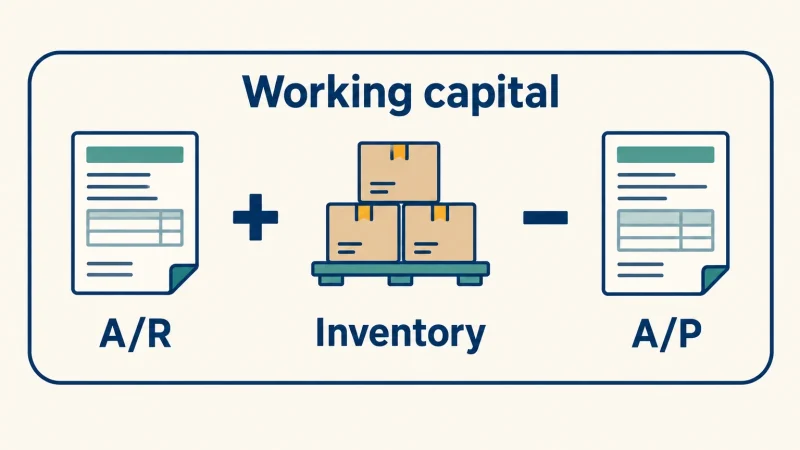
It also means a business can have inventory, customers, and profits on paper while still needing cash to bridge the gap between paying expenses and collecting customer payments.
Buyers need to understand your normal operating cycle:
A historical working capital analysis helps establish a reasonable starting point. The parties then negotiate what transfers and how any shortfall or excess will be handled.
Your job isn’t to become a working capital specialist overnight. It’s to know these questions are coming and have records your advisors can use.
A buyer may need financing for more than the payment to you.
The transaction may also require working capital so the business can operate after closing. The SBA 7(a) program permits both changes of ownership and working capital financing, including multipurpose loans. Approval still depends on the borrower’s repayment ability and the lender’s analysis.
When working capital is financed with debt, the related debt payments affect debt service coverage ratio, or DSCR: the relationship between available cash flow and required principal and interest payments.
In plain English: the business needs to support the financing package, not just the purchase price.
If the buyer must borrow more because important operating resources aren’t transferring, that additional borrowing can make the transaction harder to support.
That doesn’t mean you must leave every dollar in the business. It means “the buyer can just borrow more” isn’t a complete financing plan. It’s a sentence the lender still has to agree with.
Before accepting an offer, make sure you and your advisors can answer these questions:
These terms belong in the early deal discussion and should be documented clearly, then carried through into the definitive agreements. Waiting until closing approaches leaves more room for conflicting assumptions and puts the deal at risk.
You don’t have to settle every accounting detail in the first conversation.
But you do need more than, “We agreed on $1.5 million. We’ll figure out the rest.”
The rest can change what $1.5 million actually means.
You deserve fair compensation for the business you’ve built.
The buyer needs to know what they’re receiving and whether the business can operate successfully after you leave.
Those goals aren’t enemies.
The trouble starts when cash, receivables, inventory, debt, and working capital get treated as interchangeable, or when each person assumes the other understands the price the same way. You know what they say about making assumptions…
Start with one practical step: ask your CPA and transaction advisor to walk through your balance sheet with you. Identify the assets, obligations, and operating needs a future buyer will ask about. If those reports aren’t current or reliable, getting your books in order is a useful place to begin.
You don’t need all the answers today.
You need enough clarity to negotiate deliberately. Before you agree on the number, agree on what the number buys. The last thing you want is for you and the buyer to be negotiating two different deals.
If this raised questions about what else a buyer might expect, start with Before You Burn Out: The Seasoned Owner’s Pre-Retirement Checklist.
It offers a private look at your timeline, financial readiness, owner dependency, and business risks so you can identify one or two areas worth addressing first. You don’t have to be ready to sell to benefit from getting ready.

Heather Williams is a small business buyer and founder of HCW Biz Advisors. Alongside her husband Chris, she evaluates and pursues small business acquisitions while helping owners of established, service-based businesses prepare for a future sale with more clarity, confidence, and options.
