If your business depends on a license you hold personally, a buyer may need more than your promise to stay on as a consultant. Learn why a license transition plan matters before you sell a plumbing company, contractor business, or other licensed service business.

You’ve spent decades building a plumbing company people count on.
Your technicians know the work. Your office team knows how to keep the schedule moving. You’ve got longtime customers who call your company first when a water heater fails, a pipe bursts, or a job goes sideways.
You’re thinking about retirement, and you want to do right by the people who helped you build the business.
So when a serious buyer says, “Would you stay on for a while to help with the transition?” your answer is yes.
Of course it is.
You want the buyer to understand the business. You want employees to feel supported. You want customers to know the company will still be in good hands after you step back.
Starting October 1, 2026, new SBA guidance gives sellers in certain SBA financed business sales more room to do exactly that. A seller may remain involved as a paid consultant for up to 24 months after closing, rather than the previous 12-month maximum.
On the surface, that sounds like good news.
In many ways, it is.
But then someone asks a question that can change the conversation:
If you stepped back after the sale, who could legally keep the business operating?
If your plumbing company depends on a license held by you personally, “I’ll stay on as a consultant” might not be a complete answer.
You don’t need to become an SBA lender or a licensing attorney. But if your business depends on your license today, you need a plan for who can legally keep it operating when you step back.
Want to read the full SBA guidance? You can find SBA SOP 50 10 8.1 here. This article is meant to help you spot a business sale readiness issue early. It is not legal, tax, lending, or licensing advice.
The New SBA Rule Is Good News. It Just Isn’t the Whole Answer.
The new 24-month consulting period is good news.
It gives a seller more time to transfer relationships, explain how the business really works, and help employees and customers adjust to new ownership.
For a plumbing company, that can mean helping the buyer understand:
Those things matter. A business is more than financial statements and equipment.
A good transition takes time, and the SBA’s extended consulting allowance recognizes that reality.
But a consulting agreement and a license transition plan aren’t the same thing.
The SBA may allow you to remain as a consultant, while your state licensing board may have separate rules about who can legally serve as the qualifying person for the business.
In other words, the new rule can strengthen a good transition. It doesn’t automatically solve the licensing question.

Let’s go back to the plumbing company as an example.
Maybe you are the person tied to the contractor license. The buyer doesn’t hold the required license yet. You tell them, “That’s okay. I’ll stay on for two years as a consultant and make sure everything runs smoothly.”
That may be helpful for the business.
But it may not be enough for the license.
In California, a business can have a Responsible Managing Employee, often called an RME, serving as the qualifying individual for a contractor license.
An RME isn’t simply an outside advisor who lends their name to the company. They must be a bona fide employee who is actively engaged in the contracting business and the licensed classification of work. California’s rules generally require an RME to work at least 32 hours per week, or 80% of the business’s weekly operating hours, whichever is less.
So if you step away as an employee at closing and stay only as a consultant, you may not be able to continue serving as the company’s RME.
That doesn’t mean you cannot sell your plumbing company.
It means you need to answer a more useful question before the business goes to market:
Is there a qualified employee who can legally serve in that role after closing, or does the buyer have a compliant path to do it?

That is a much better conversation to have while you still have time to plan than after you have accepted an offer, introduced a buyer to your employees, and started picturing your next chapter.
This Isn’t Only a Plumbing Company Issue
This isn’t only a plumbing company issue.
It can come up in HVAC, electrical, auto repair, auto glass, pest control, security, landscaping, tree service, and other licensed service businesses.
If one person’s license, registration, approval, or qualifying status is central to keeping the company operating legally, a thoughtful transition plan protects more than the deal.
It helps protect your employees, customers, and the legacy you built.
For example, California automotive repair businesses generally need a new Automotive Repair Dealer registration after a change in ownership. If applicable, the buyer may also need new station licenses. The business cannot operate until the Bureau of Automotive Repair issues the required registration and licenses.
A structural pest control company must have properly licensed qualifying manager(s) designated to supervise the daily business and employees.
The specific rules are different across industries. But the seller readiness question is similar:
If the current owner steps back, what has to be true for the business to keep operating legally and confidently on Day 1?
The California plumbing example is useful because the rules are clear and familiar to many local trade businesses. But licensing rules vary by state, industry, entity structure, and the role of the person holding the credential.
If your business isn’t based in California, don’t assume California’s rules apply to you.
Check your state licensing regulations. Then talk with the appropriate licensing professional, transaction attorney, and experienced SBA lender before you list your business.
Don’t Assume a Stock Sale Solves the Licensing Issue
You may hear someone say, “We’ll just do a stock sale.”
Maybe.
But don’t assume a stock sale solves every licensing issue.
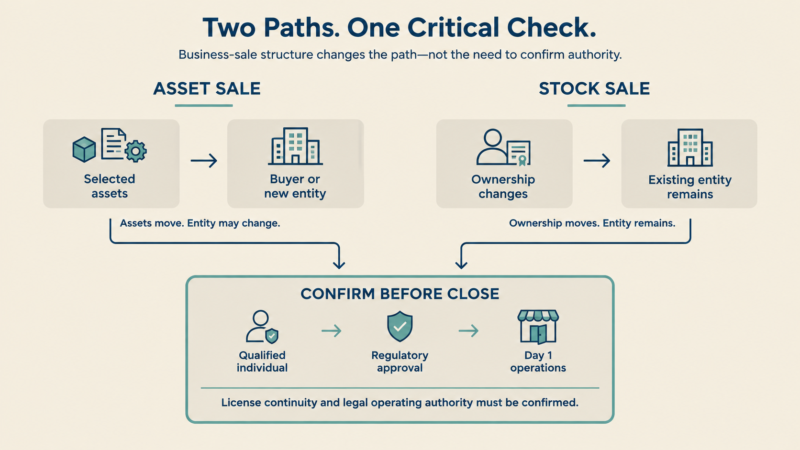
In an asset sale, a buyer usually acquires specific business assets and operates them through a new or different entity. In a stock sale, the buyer purchases ownership of the existing company, so the legal entity may remain in place.
That difference can matter.
In some situations, keeping the same entity may affect how an entity-held license is treated. But if you are also the person who qualifies the company to hold the license and you plan to step back after closing, the licensing question does not disappear.
The business may still need:
A stock sale may change the path. It doesn’t eliminate the need for a legally compliant transition plan.
For California contractors, the CSLB states that a new license is required when a business entity changes in certain ways. It also requires reporting changes in license personnel within 90 days.
This is why you need the right professionals to evaluate the actual facts of your business and proposed transaction. Deal structure has legal, tax, liability, lender, and licensing implications. There is no one-size-fits-all answer.
Don’t Write Off SBA Buyers
It may be tempting to think, “If this makes an SBA-financed sale more complicated, I’ll just sell to someone who isn’t using SBA financing.”
But before you make that assumption, it is worth understanding what you may be giving up.
For many people buying an established small business, SBA-backed financing is one of the most realistic ways to make the purchase happen. The SBA 7(a) program is specifically available for changes of ownership, including business acquisitions, and can provide loans of up to $5 million.
That matters because most buyers do not have enough cash to buy a healthy plumbing company, HVAC company, auto repair business, or other established service business outright.
They may have savings for a down payment, strong credit, relevant management experience, and a real plan for running the business. But they still need financing that gives the business enough room to support the new owner, make loan payments, invest in operations, and keep serving customers.
That is where SBA financing can be a good thing for a seller.
An SBA buyer is not simply someone asking a bank for money. The lender will look closely at both the business and the buyer. The process typically requires the lender to review the buyer’s financial capacity, experience, credit, equity contribution, and ability to manage the company. The lender also reviews the business’s historical financial performance, cash flow, debt obligations, and whether the business can support the proposed loan payment.
That scrutiny can feel demanding. But from a seller’s perspective, it can also be reassuring.
It means a lender has an independent reason to ask:
“Can this buyer realistically take over this business, and can this business support the transaction?”
No financing path guarantees a smooth closing. And an SBA loan is not the right fit for every buyer or every business.
But choosing not to consider SBA buyers at all can seriously shrink your pool of potential buyers. You may be limiting yourself to people with substantial cash, access to conventional financing, private-equity backing, or a very specific financial profile.
For many main street and lower-middle-market service businesses, that is a much smaller group.
The better approach is not to avoid SBA buyers.
It’s to prepare your business so an SBA buyer, their lender, and the right advisors can see a clear path to a stable transition.
Why This Matters to More Than the Deal
A license transition plan is not only about getting a deal closed.
It is about giving the people who depend on your business a steadier handoff.
Your employees deserve to know the company can keep operating. Your customers deserve confidence that the business they trust will continue serving them. And the buyer deserves a realistic plan instead of a problem they discover after closing.
You might be tempted to think, “Isn’t this the buyer’s problem?”
The buyer will have responsibilities, of course. They need to understand whether they can qualify the business, hire the right person, obtain approvals, and secure financing.
But if you want to keep more financing options open and protect the people who rely on the business, this is worth addressing before you list.
A serious buyer may be ready to move forward. The cash flow may look strong. The customer base may be stable. The buyer may even be a great cultural fit for your employees.
Then a lender, attorney, licensing board, or buyer-side advisor asks how the business will legally operate after closing.
If nobody has a clear answer, the uncertainty can create friction.
A buyer may get nervous. Their lender may ask more questions. The timeline may stretch. The buyer may decide they need to reduce the price, change the deal terms, or walk away because the transition feels riskier than they expected.
That isn’t fear-mongering. It is how buyers evaluate uncertainty.
Buyers don’t just buy your equipment, revenue, and customer list. They buy the ability of the company to keep operating after you are no longer carrying every important responsibility.
This is also why owner dependency matters so much in a future sale. If essential knowledge, relationships, approvals, or credentials live with one person, a buyer needs confidence the business can continue without that person doing everything forever.
That doesn’t make your business unsellable.
It simply tells you where preparation can make a meaningful difference.
If you want another perspective on owner-dependent risks that can surface during a sale, check out Are You the Reason Your Deal Will Break?.
How to Start Building a License Transition Plan
You don’t need to solve every licensing question this week.
You also don’t need to announce you are thinking about selling, tell your employees, or rush into a transaction structure.
Start by getting clear on what exists today.
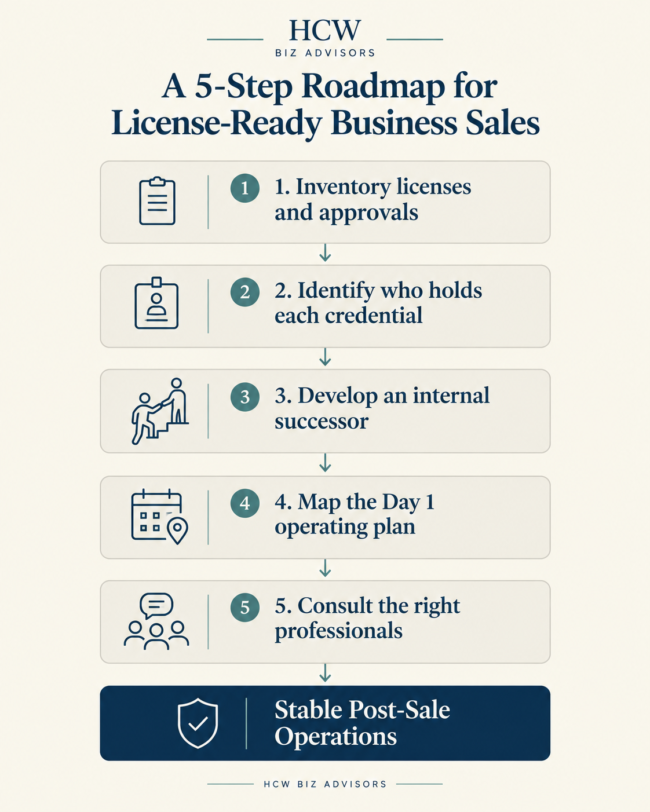
1) Make a list of what lets your business operate
Write down every license, registration, permit, approval, and qualifying-person requirement your company needs to operate.
Depending on your business, that may include:
Do not rely on memory.
A simple list gives you a starting point for the conversations you will eventually need to have.
2) Identify where each credential lives
For every item on your list, ask:
If you are the only person who can qualify the business, that’s not something to be ashamed of.
It’s simply important buyer-readiness information.
A buyer can’t plan for a dependency they don’t understand. And you can’t decide what to improve until you know where the dependency is.
3) Look for an internal successor
This may be the most useful place to start.
Ask yourself whether there’s a trusted employee who could eventually become the qualified person for the business.
Maybe it’s a longtime technician who knows the trade inside and out. Maybe it’s an operations leader who already carries more responsibility than you realize. Maybe it’s someone who needs more experience, testing, training, or a formal development plan before they are ready.
You’re not handing someone a title overnight.
You’re identifying potential early enough to create options.
An internal successor may need time to meet experience requirements, prepare for an exam, complete paperwork, understand their responsibilities, or satisfy the requirements of the applicable licensing board. But if you start early, you can develop a credible continuity plan while the business is still stable and you’re still available to mentor them.
That can make the handoff easier on the buyer, your employees, and your customers.
It can also make your business more transferable.
4) Map the Day 1 plan
Ask one direct question: If I no longer worked here after closing, who could legally keep this business operating?
There may be several possible answers.
The buyer may already hold the appropriate credential. A qualified employee may be able to serve in the necessary role. The buyer may have a realistic, documented plan to qualify or hire someone who can.
The right answer will depend on your business, state rules, entity structure, buyer, and licensing requirements.
The important thing is not to guess.
The important thing is to identify the question before you’re in the middle of due diligence, when every uncertainty can feel bigger and more urgent.
If you’d like a clearer picture of what buyers may ask during a sale process, read What to Expect in Due Diligence When You Sell Your Small Business.
5) Get the right people involved early
You don’t need to become the licensing expert.
You need to bring the right questions to the right people early enough to use their answers.
That may include:
This is especially important if you’re considering an asset sale, stock sale, seller consulting agreement, internal successor plan, or other structure that could affect licensing and operations after closing.
The goal isn’t to create more work for yourself.
The goal is to avoid discovering a preventable issue when you’re tired, emotionally invested in a buyer, and ready to be done.
Prepare While You Still Have Options
The best time to think about a license transition plan is not after a buyer asks for one.
It’s while you’re still running a stable business, still have time to develop someone internally, and still have choices about how you want the transition to work.
You may find that the answer is simple. Perhaps the buyer already has the right license. Maybe a key employee is ready to step into the qualifying role. Or maybe you simply need time to put a plan in place.
Whatever the case, knowing early gives you more control.
It gives your employees a steadier handoff.
It gives your customers more confidence.
And it gives a future buyer a clearer picture of the business they’re considering carrying forward.
If this article made you think, “My business may depend on me in more ways than I realized,” you don’t need to solve every transition question today.
Start by getting a clearer picture of where you stand.
Download Before You Burn Out: The Seasoned Owner’s Pre-Retirement Checklist.
In about five minutes, you’ll get a private snapshot of:
It’s not a test.
And it doesn’t mean you’re ready to list your business.
It’s simply a practical first step toward protecting your team, customers, future options, and legacy before you’re under pressure.
Download the Before You Burn Out: The Seasoned Owner’s Pre-Retirement Checklist here.

Heather Williams is a small business buyer and founder of HCW Biz Advisors. Alongside her husband Chris, she evaluates and pursues small business acquisitions while helping owners of established, service-based businesses prepare for a future sale with more clarity, confidence, and options.
