A buyer may love your business and agree to your price, but their lender still has to believe the business can support the acquisition. Learn what the bank evaluates and how early preparation can reduce financing surprises.

You accepted the offer.
The buyer likes the business. They understand what you built. They seem like someone who will take care of your employees and customers. The purchase price feels fair, and both of you are ready to keep moving.
For the first time, you let yourself picture closing day.
Then the lender starts asking questions.
How was the price supported?
Which addbacks can be verified?
Can the business support the proposed loan payments?
Can it also pay the buyer enough to support their household?
What happens if revenue dips, an important customer leaves, or the business needs a new piece of equipment?
Can the buyer run the company after you step away?
Suddenly, the transaction doesn’t feel quite as settled as it did when you accepted the offer.
Here’s the part many owners don’t realize until they’re already in a deal:
The buyer was deciding whether they wanted your business. The bank is deciding whether the business can afford the transaction.
If the buyer needs financing, their enthusiasm isn’t the final vote. Their lender also has to believe the purchase price, loan amount, buyer, and post-closing business make sense together.
That doesn’t mean you need to become an SBA lending expert before you sell.
But if you want to avoid preventable financing surprises, it helps to understand what the bank will eventually see.
This article is intended to help business owners recognize a sale-readiness issue before going to market. It is not lending, legal, tax, valuation, or financial advice. Loan requirements and underwriting decisions vary by lender and transaction. You can review the current SBA SOP 50 10 guidance here.
Why the bank gets a vote
Many buyers don’t have enough cash to purchase a healthy, established business outright.
They may have savings for an equity contribution, strong credit, relevant experience, and a real plan for taking over. But they still need a loan to complete the acquisition.
For many small business acquisitions, the SBA 7(a) program is an important financing option. The SBA doesn’t lend the money directly. An approved lender makes the loan, applies its underwriting standards, and receives an SBA guarantee on a portion of the loan. SBA 7(a) proceeds can be used for a change of ownership.
Conventional bank financing may also be available. A conventional lender may require more buyer equity, stronger collateral, or a different level of cash flow coverage. Its exact criteria can vary because the loan isn’t governed by the SBA operating procedure.
But whether the buyer pursues SBA-backed or conventional financing, the core question is similar:
Can this business reliably support the new debt and its new owner after closing?
A buyer saying, “I can make this work,” isn’t enough for the lender.
The bank needs documentation.
The bank evaluates two investments
When a lender reviews a business acquisition, it isn’t only evaluating your company.
It’s also evaluating the person buying it.
On the business side, the lender may review:
On the buyer side, the lender may consider:
Current SBA guidance for change-of-ownership transactions directs lenders to analyze the business’s historical financial performance, current interim results, repayment ability, working capital adequacy, and the buyer’s management structure and experience. It also requires an independent business valuation to support the purchase price, with any excess generally covered by additional equity rather than a larger SBA loan.
In other words, a strong business can still be paired with the wrong buyer. And a capable buyer can still pursue a business priced beyond what its cash flow supports.
The bank is evaluating whether the combination works.
The asking price is not the whole equation
A seller may look at the company’s earnings, apply a market multiple, and conclude the price is fair.
The buyer may agree.
But the lender must look at what happens after the sale introduces a large new obligation: acquisition debt.
This is where debt service coverage ratio, or DSCR, enters the conversation.
The name sounds technical. The idea isn’t.
DSCR compares the cash flow available for debt payments with the annual principal and interest payments the business will owe.
A ratio of 1.00 means the business produces exactly enough qualifying cash flow to pay the debt, with nothing left as a cushion. A ratio of 1.25 means it produces $1.25 for every $1.00 of annual debt payments.
Under the SBA guidance effective October 1, 2026, an initial acquisition must meet a 1.25-to-1 DSCR requirement using the prescribed historical or adjusted financial analysis. Individual lenders may still apply stricter credit standards.
And the buyer may have a higher standard of their own.
A bank’s willingness to approve a loan doesn’t automatically make the acquisition comfortable for the buyer. A disciplined cash flow buyer may aim for a 1.5 DSCR because they want more room for normal surprises, reinvestment, and growth. Acquisition professionals often treat 1.25 as a financing threshold and 1.35 to 1.50 as healthier coverage.
The business must work for the lender, but it also has to make economic sense for the buyer.
What the math can look like
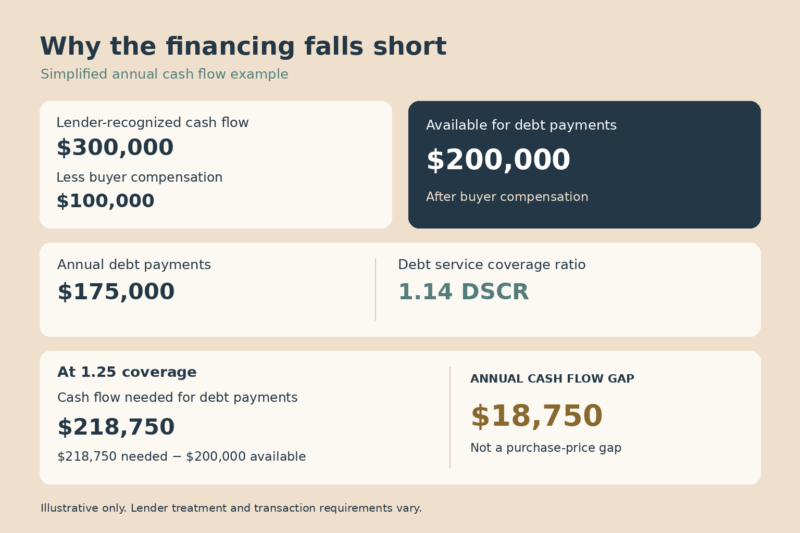
Suppose a business produces $300,000 in annual cash flow recognized by the lender.
For this simplified example, assume the lender includes $100,000 in annual compensation for the buyer. The actual amount and treatment can vary based on the buyer’s obligations and the lender’s analysis.
That leaves $200,000 available before acquisition debt payments.
Now suppose the proposed loan requires $175,000 in annual principal and interest payments.
The business can technically make the payment, but the DSCR is only about 1.14. To reach a 1.25 DSCR, the lender would need to see $218,750 available for those payments.
The deal is short by $18,750 in annual lender recognized cash flow.
The business is profitable. The buyer likes it. The seller may have good reasons for believing the price is fair.
But at this price and financing structure, there isn’t enough breathing room to meet the SBA coverage requirement.
A buyer targeting a 1.5 DSCR would want even more cushion. They aren’t necessarily trying to get a bargain. They may be asking whether the business can pay the debt, pay them, replace equipment, absorb a slow month, and still fund reasonable growth.
This is the real question behind the formula:
After paying the buyer and the bank, is there enough room left for the business to handle real life?
The bank may not accept every addback
This is another place where sellers can be surprised.
Perhaps you run personal vehicle expenses through the business. Maybe you attended a one-time conference, paid a family member above market, made an unusual repair, or incurred a legal expense that will not continue after the sale.
Some adjustments may be reasonable.
Others may be hard to document, may continue under new ownership, or may not fit the lender’s definition of sustainable cash flow.
Current SBA guidance allows prudent cash flow adjustments, including certain seller discretionary expenses and ownership compensation. It also requires the lender to explain why each adjustment is necessary, supportable, and consistent with the business’s ongoing operations. Unsupported adjustments are not eligible for the core debt service analysis.
This is why a listing can advertise one cash flow number while the lender recognizes another.
The bank does not finance the story you tell about your business. It finances the cash flow and value it can verify.
Clean records, reconciled tax returns, and well-documented addbacks don’t guarantee approval. They do make it easier for the buyer and lender to understand what the business actually produces.
If your financial records need attention, read Why Clean Books Might Be the Most Profitable Decision You Make Before Selling Your Service-Based Business.
When the lender won’t support the deal
Suppose you accepted an offer for $1.5 million.
Several weeks later, the buyer returns and says:
“The bank won’t support the transaction at this price. We need to reduce the purchase price, increase my equity contribution, or change the structure.”
Your first reaction may be:
You already agreed to my price. Why are we reopening this?
That reaction is understandable.
It’s possible the buyer may be using financing as cover to reopen negotiations.
It’s also possible the buyer still wants the business and has run into math neither party can ignore.
A lender’s refusal to support the agreed price doesn’t automatically mean your business has no value. It may mean the bank cannot support this price, this structure, and this buyer using the cash flow and value it recognizes.
The possible responses may include:
Seller financing can sometimes help structure a workable transaction, but it isn’t free money and it isn’t an automatic cure for an overpriced deal. A seller note introduces repayment risk for the seller and deserves its own careful analysis.
A different lender may also view an addback, risk, or buyer qualification differently. But changing lenders won’t create cash flow the business doesn’t produce.
There isn’t always a responsible way to bridge the gap.
Buyers shouldn’t be expected to overpay simply to keep a transaction alive. A cash flow buyer needs a fair and reasonable price that allows the business to service its debt, compensate the new owner, withstand ordinary disruption, and retain enough capacity to grow.
If the business can’t do those things, walking away may be the responsible decision.
Prepare before a buyer appears
You can’t control every lender’s underwriting decision. You also can’t know the future buyer’s exact salary needs, experience, equity contribution, or financing terms before meeting them.
But you can make the business easier to evaluate.

If a sale is still a few years away:
As you get closer to listing:
Before accepting an offer:
This isn’t about letting a bank dictate what your business means to you.
It’s about understanding what the transaction must support before you’re emotionally committed to one buyer and one outcome.
Prepare before the transaction takes over
A good CPA, broker, acquisition lender, and transaction attorney can each play an important role as you get closer to a sale.
But there’s also valuable work to do before you need a full deal team.
My role is to help you prepare before the transaction takes over.
I help established small business owners examine their companies through the buyer-and-lender lens while there is still time to improve the financial story, document important details, reduce avoidable risk, and decide which issues deserve attention first.
You don’t need to know which buyer will eventually appear.
You don’t need to predict which bank they’ll use.
You need a business whose cash flow, risks, operations, and transition plan are clear enough for serious buyers and their lenders to evaluate with confidence.
If this article made you wonder whether your business is ready for those questions, start with a private snapshot of where you stand.
Download the Before You Burn Out: The Seasoned Owner’s Pre-Retirement Checklist.
In about five minutes, it will help you assess:
It isn’t a test.
It doesn’t mean you’re ready to list.
It is a practical first step toward preparing before a buyer, lender, or deadline puts you under pressure.
Download the Before You Burn Out: The Seasoned Owner’s Pre-Retirement Checklist here.

Heather Williams is a small business buyer and founder of HCW Biz Advisors. Alongside her husband Chris, she evaluates and pursues small business acquisitions while helping owners of established, service-based businesses prepare for a future sale with more clarity, confidence, and options.
